
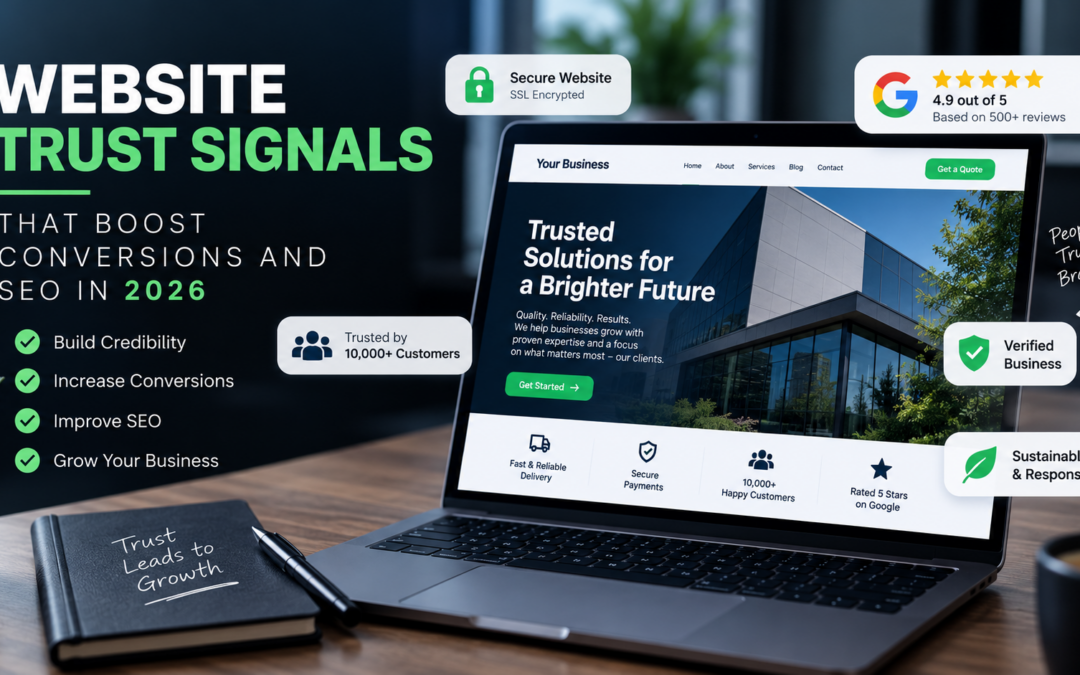
Website Trust Signals That Boost Conversions and SEO in 2026
Trust is one of the most important factors influencing whether a visitor becomes a lead, customer, subscriber, or repeat buyer. In 2026, website owners need to think about trust signals as more than design details. They affect how users judge a brand, how comfortable they feel taking action, and how search engines interpret the quality and credibility of a site. For small businesses and marketers, improving trust signals can support both conversion rate optimisation and long-term SEO performance.
Why Website Trust Signals Matter in 2026
Online users are more selective than ever. Before submitting a form, booking a consultation, or buying a product, they look for signs that a business is legitimate, reliable, and easy to contact. If those signals are missing, even strong traffic can fail to convert.
Search engines also reward websites that provide helpful, transparent, and trustworthy experiences. While trust signals are not always direct ranking factors on their own, they support many areas that influence SEO, including user engagement, content quality, brand reputation, and website usability.
A trustworthy website reduces hesitation. It answers common questions, shows proof of credibility, and removes uncertainty at key decision points. The result is a smoother journey from landing page to conversion.
Clear Contact Information
One of the simplest trust signals is also one of the most overlooked: clear contact information. Visitors want to know that a real business is behind the website. A visible phone number, email address, contact form, business address, and opening hours can all help build confidence.
For local businesses, consistent contact details are especially important. Your name, address, and phone number should match across your website, Google Business Profile, directories, and social platforms. Inconsistent information can confuse customers and weaken local SEO signals.
Practical tips for better contact trust
Add contact details to your header, footer, and contact page. If you serve a specific area, include that location information naturally on relevant pages. Make sure forms are easy to use, confirmation messages are clear, and users know when to expect a response.
Secure and Professional Website Experience
A secure website is a baseline expectation. If visitors see browser warnings, broken pages, outdated layouts, or suspicious pop-ups, they are unlikely to stay. Security and professionalism directly influence how people perceive your business.
Every business website should use HTTPS, keep software updated, remove broken links, and ensure forms work correctly. These elements support both trust and technical SEO. A site that loads properly, protects user information, and feels professionally maintained is more likely to keep visitors engaged.
Design consistency also matters. Fonts, colours, spacing, images, and calls to action should feel intentional. A cluttered or outdated design can make a business appear less credible, even if the service itself is excellent.
Authentic Reviews and Testimonials
Customer reviews are among the most powerful trust signals because they provide social proof. People want to know whether others have had a positive experience before they take the next step.
For service businesses, testimonials can help explain the quality of your work, communication style, and results. For ecommerce websites, product reviews can reduce uncertainty around quality, delivery, sizing, or suitability.
Reviews should be authentic, specific, and easy to find. Avoid vague testimonials that simply say “great service” without context. Stronger testimonials explain the customer’s problem, the solution provided, and why they were satisfied.
Where to place reviews
Add testimonials to key landing pages, service pages, product pages, and checkout or enquiry areas. If you collect reviews on third-party platforms, link to those profiles where appropriate. This helps visitors verify feedback and adds credibility beyond your own website.
Detailed About Page and Brand Story
Your About page is often one of the most visited pages by users who are considering whether to trust your business. A generic About page is a missed opportunity. Instead, use it to explain who you are, what you do, who you help, and why your business exists.
For small businesses, a personal and transparent About page can be a major advantage. Introduce the founder, team members, values, experience, and approach. If relevant, include professional photos rather than relying only on stock imagery.
Search engines aim to understand the people and organisations behind websites. A clear About page supports that understanding while helping users feel more confident in your brand.
Author Bios and Content Credentials
If your website publishes guides, blog posts, advice, or industry commentary, visitors should know who created the content. Author bios help establish expertise and accountability, especially in industries where decisions involve money, health, legal issues, property, or professional services.
An effective author bio does not need to be long. It should explain the author’s role, experience, and relevant background. If multiple team members contribute content, create individual author pages where readers can see more of their work.
This is particularly useful for SEO-focused content strategies. Helpful content is stronger when it is connected to real knowledge, practical experience, and a clearly identified source.
Transparent Policies and Terms
Trust also comes from transparency. Users should be able to find your privacy policy, terms and conditions, returns policy, delivery information, cancellation policy, or booking terms without searching too hard.
For ecommerce businesses, unclear returns or delivery information can cause cart abandonment. For service businesses, unclear payment terms or cancellation rules can create friction before enquiry or booking.
Place policy links in the footer and include key details on relevant conversion pages. For example, an online shop should show delivery and returns information close to product and checkout areas. A consultancy or appointment-based business should explain booking steps clearly before the user commits.
Strong Case Studies and Portfolio Examples
Case studies and portfolio examples help potential customers understand what you can actually deliver. They are especially valuable for agencies, consultants, trades, designers, developers, and B2B service providers.
A useful case study should explain the client’s challenge, your approach, and the outcome in a way that is accurate and easy to understand. You do not need to share confidential data or make exaggerated claims. The goal is to show your process, problem-solving ability, and the type of work you handle.
For visual businesses, before-and-after examples, screenshots, project galleries, or videos can be effective. For professional services, summaries of challenges and solutions may be more appropriate.
Recognisable Payment, Checkout, and Form Signals
Conversion points need extra trust. When a visitor reaches a checkout, quote form, booking form, or download form, they are making a decision that involves personal information, money, or time.
Make forms simple and explain why you need the information requested. Avoid asking for unnecessary details. Add reassurance near the form, such as response times, secure processing messages, privacy notes, or links to relevant policies.
For ecommerce sites, show accepted payment methods clearly, explain shipping costs before the final step where possible, and avoid surprise charges. A smooth and transparent checkout experience can reduce hesitation and improve completed purchases.
High-Quality Content That Answers Real Questions
Trust is not only built through design elements. Content plays a central role. Helpful, accurate, and well-structured content shows that your business understands customer needs.
In 2026, thin pages written only to target keywords are unlikely to perform well. Small businesses should focus on answering real questions that customers ask before buying. This can include pricing considerations, service comparisons, process explanations, maintenance tips, buying guides, and common mistakes to avoid.
Strong content can improve search visibility while supporting conversions. A visitor who finds clear answers on your site is more likely to see your business as knowledgeable and reliable.
Content trust checklist
Review important pages and ask whether they clearly explain who the page is for, what problem it solves, what the next step is, and why the visitor should trust your business. Update outdated information and remove claims that cannot be supported.
Consistent Branding Across Channels
Users often interact with a business across several channels before converting. They may find you through search, visit your website, check social media, read reviews, and return later through a paid ad or email.
Consistent branding across these touchpoints helps build familiarity. Your logo, tone of voice, business description, services, contact details, and visual style should align across your website, social profiles, directory listings, email templates, and advertising campaigns.
Inconsistency can create doubt. If your website says one thing but your profiles say another, visitors may question whether the business is active or reliable.
Fast Loading and Mobile-Friendly Pages
Performance is a trust signal. Slow pages frustrate visitors and can make a website feel outdated. Mobile experience is especially important because many users research, compare, and contact businesses from their phones.
Make sure pages load quickly, buttons are easy to tap, text is readable, images are optimised, and menus are simple to use. A strong mobile experience supports SEO and makes it easier for users to convert without friction.
Small improvements can have a meaningful impact. Compress oversized images, remove unnecessary plugins, simplify page layouts, and test key conversion paths on different devices.
How to Audit Your Website Trust Signals
Start by reviewing your most important pages: homepage, service pages, product pages, About page, contact page, and checkout or enquiry forms. Look at each page from the perspective of a first-time visitor who does not know your business.
Ask whether the page clearly shows who you are, what you offer, how to contact you, why you are credible, and what the visitor should do next. Check for missing reviews, weak calls to action, outdated content, broken links, unclear policies, or poor mobile usability.
It can also help to ask customers or team members what questions they had before making a purchase or enquiry. Use those questions to improve page content and reduce uncertainty.
Final Thoughts
Website trust signals are not just cosmetic additions. They influence how visitors feel, how easily they make decisions, and how search engines understand the quality of your site. In 2026, businesses that combine transparent information, strong content, secure browsing, authentic reviews, and smooth user experience will be better positioned to convert traffic into customers.
For small businesses and marketers, the best approach is to start with the basics: make your business easy to verify, easy to contact, and easy to buy from. Trust grows when every page removes doubt and gives visitors a clear reason to take the next step.