by admin | Oct 20, 2026 | Event Marketing, Exhibitions & Events, Marketing
What Is an Ice Cream Bike and How Does It Work?
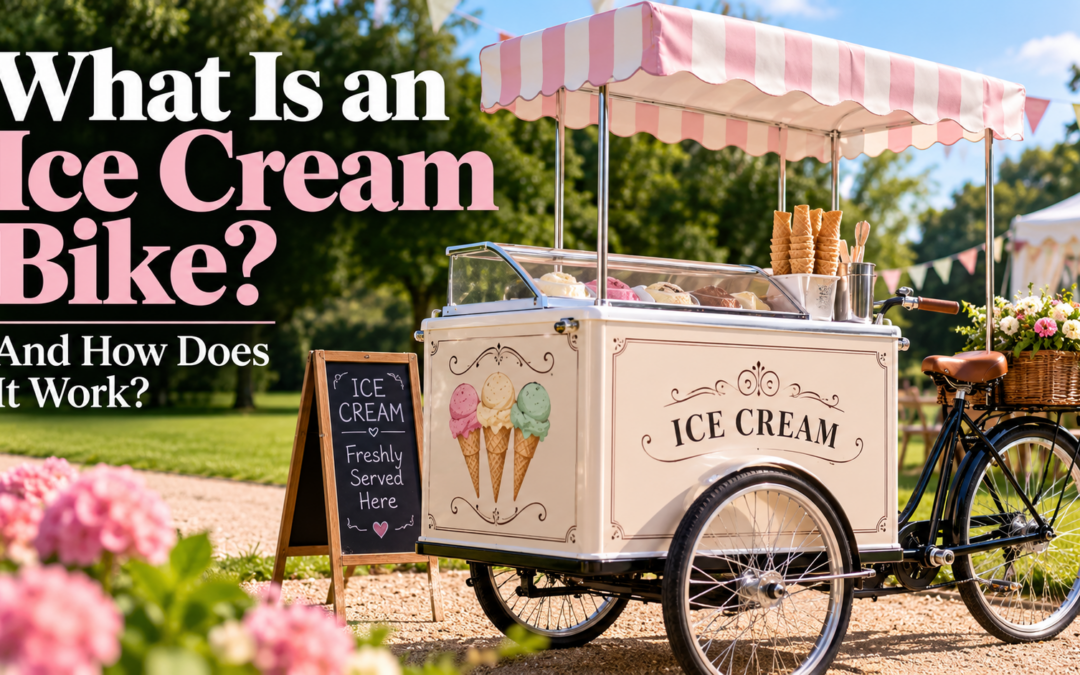
An ice cream bike is a specially designed bicycle or tricycle fitted with an insulated freezer or refrigerated storage compartment for selling and serving ice cream. Also known as an ice cream tricycle or mobile ice cream cart, it allows businesses to transport frozen products, serve customers and operate in locations where a traditional ice cream van or permanent shop may not be practical.
Ice cream bikes are increasingly popular with independent businesses, event organisers, hospitality venues and established ice cream brands looking for a flexible and eye-catching way to serve customers.
Whether you’re considering launching a mobile ice cream business, adding another sales opportunity to an existing operation or hiring a bike for an event, understanding how these mobile units work is essential.
At Urban Tricycles, we design and manufacture British-made ice cream carts and tricycles that combine traditional styling with modern refrigeration technology.
In this guide, we’ll explain how ice cream bikes work, what features they offer and how to choose the right model for your business.
What Is an Ice Cream Bike?
An ice cream bike is a mobile vending unit designed to transport, store and serve ice cream while maintaining the appropriate frozen temperature.
Most commercial ice cream bikes are built around a three-wheeled frame, providing stability and space for an integrated freezer.
Unlike a traditional ice cream van, an ice cream tricycle is compact and can be positioned in pedestrian areas, outdoor venues and other suitable locations.
The freezer compartment may be designed to hold pre-packaged ice creams, individual tubs or larger containers for scooping.
Our range of ice cream bikes and tricycles includes different configurations to suit businesses of all sizes.
How Does an Ice Cream Bike Work?
An ice cream bike works by combining a mobile tricycle or cart frame with a freezer system that keeps ice cream at a suitable temperature during storage and service.
The refrigeration system varies depending on the model.
Some units use mains electricity, while others incorporate battery-powered cooling or thermal storage solutions.
1. Refrigerated Storage
The most important feature of any ice cream bike is its freezer compartment.
Commercial ice cream tricycles are designed to maintain frozen products at suitable temperatures, helping protect food quality throughout the trading period.
For example, the Urban 12V Ice Cream Tricycle features a 191-litre freezer compartment with a stated operating temperature range of -14°C to -24°C.
The appropriate operating temperature depends on the product being served, the manufacturer’s instructions and food safety requirements.
2. Power Supply
Different ice cream bikes use different power arrangements.
Mains-powered systems require a suitable electrical connection, which may be ideal for fixed trading pitches, markets or events with accessible electricity.
Battery-powered models offer greater flexibility where mains electricity is unavailable.
Some systems can also incorporate eutectic plates, which are frozen in advance and help maintain low temperatures for a period without continuous electrical cooling.
However, the length of time an ice cream bike can operate depends on factors such as ambient temperature, freezer loading, lid opening frequency and the cooling system.
3. Mobile Design
The tricycle frame makes the unit easier to reposition than a larger commercial vehicle.
Depending on the design, ice cream bikes may be pedalled, pushed or fitted with electric pedal assistance.
This mobility makes them suitable for locations where access for conventional vehicles is limited.
4. Serving Customers
Once positioned at a suitable trading location, the operator can access the freezer compartment and serve customers directly.
Some models are configured for individual wrapped products, while others include display systems for scooping ice cream from larger containers.
How Do Ice Cream Bikes Keep Ice Cream Cold?
Ice cream bikes keep products frozen using a combination of insulation, refrigeration and, in some models, pre-frozen cooling plates.
Commercial freezer compartments are designed to minimise heat transfer and maintain a consistent internal temperature.
The cooling method is particularly important when operating outdoors during warmer weather.
Mains-Powered Freezers
A mains-powered ice cream freezer uses an electrical refrigeration system to maintain the required temperature.
This arrangement is useful for businesses operating at a regular location with access to electricity.
Battery-Powered Refrigeration
Battery-powered systems offer additional flexibility for mobile vending.
Our 12V ice cream carts and tricycles combine traditional styling with modern cooling technology, making them suitable for a range of trading environments.
Eutectic Cooling Plates
Eutectic plates contain a specially formulated material that stores cooling energy when frozen.
When placed inside a suitable insulated compartment, they help maintain low temperatures as the stored cooling energy is released.
The plates must be prepared correctly, and their cooling performance depends on the operating conditions.
Whichever system is used, operators should monitor temperatures and follow appropriate food safety procedures.
What Features Does an Ice Cream Bike Have?
Modern ice cream bikes can include several features designed to make serving customers easier and improve the appearance of the business.
Freezer Storage Capacity
Storage capacity determines how much ice cream can be carried.
Larger freezer compartments can accommodate more stock, while compact units may be better suited to smaller events or restricted spaces.
Ice Cream Display Systems
Some models can accommodate Napoli trays, allowing multiple flavours to be displayed for scooping.
For example, our Classic Ice Cream Cart can accommodate seven 5-litre Napoli tubs using an optional display system.
Canopies and Parasols
An adjustable canopy or branded parasol provides shelter and creates a recognisable mobile serving station.
Hygiene Equipment
Optional handwashing facilities, scoop-washing systems and preparation surfaces can support hygienic food service.
The exact facilities required depend on the business and its food safety arrangements.
Custom Branding
An ice cream bike can also function as a mobile advertising platform.
Custom colours, logos and graphics help create a recognisable appearance, particularly at events and promotional activities.
Where Are Ice Cream Bikes Commonly Used?
One of the biggest advantages of an ice cream bike is its versatility.
These mobile units can be used in a wide variety of settings, subject to permission and local trading requirements.
Weddings and Private Celebrations
Ice cream bikes offer an attractive serving station for wedding receptions, garden parties and private events.
Their traditional styling can complement outdoor venues and provide an alternative to a conventional dessert counter.
Festivals and Outdoor Events
Festivals, fairs and community events often attract large numbers of visitors looking for refreshments.
A mobile ice cream cart can provide a compact serving point without requiring the space occupied by a full-sized van.
Parks and Tourist Attractions
Ice cream tricycles can be suitable for parks, visitor attractions and leisure destinations where operators have permission to trade.
Their relatively compact size makes them practical for designated pedestrian-friendly areas.
Corporate Events and Brand Promotions
Branded ice cream bikes can also be used for product launches, exhibitions and promotional campaigns.
Businesses can customise their appearance to support a wider marketing activity.
Hotels and Hospitality Venues
Hotels, restaurants and leisure venues may use ice cream carts to provide additional food service during seasonal events or outdoor functions.
Ice Cream Bike vs Ice Cream Cart: What’s the Difference?
Although the terms are sometimes used interchangeably, there are differences between an ice cream bike and an ice cream cart.
An ice cream bike or tricycle normally incorporates a cycle-style frame and may be designed for pedalling or assisted movement.
An ice cream cart is generally pushed or positioned at a fixed trading location rather than ridden.
Both formats can include freezer compartments, serving surfaces and branded accessories.
For businesses looking for a larger serving station, the Deluxe Ice Cream Cart offers a 296-litre freezer compartment and optional display and hygiene equipment.
The right choice depends on how frequently the unit needs to be moved, the available space and the type of products being served.
Should You Buy or Hire an Ice Cream Bike?
Deciding whether to buy or hire an ice cream bike depends on how frequently you plan to use it.
Buying an Ice Cream Bike
Purchasing is generally more suitable for businesses planning regular or long-term use.
Ownership allows you to customise the equipment, develop consistent branding and integrate the unit into your everyday operations.
For entrepreneurs starting a mobile ice cream business, buying can provide a long-term commercial asset.
Explore our ice cream carts and tricycles for sale to compare the available designs.
Hiring an Ice Cream Bike
Hiring may be more suitable for businesses or event organisers who only need a mobile ice cream station occasionally.
It can be particularly useful for weddings, corporate functions, exhibitions and short-term promotional campaigns.
Hiring also allows businesses to assess whether a particular style of ice cream bike suits their requirements before considering ownership.
Urban Tricycles offers cart and tricycle hire for events and promotional activities.
Frequently Asked Questions About Ice Cream Bikes
Do Ice Cream Bikes Need Electricity?
Some ice cream bikes require mains electricity, while others use battery-powered refrigeration or cooling plates. The power requirements depend on the model and cooling system.
How Much Ice Cream Can an Ice Cream Bike Hold?
Capacity varies between models. For example, Urban Tricycles offers a 191-litre 12V ice cream tricycle and larger carts with 296-litre freezer compartments.
Can You Use an Ice Cream Bike at a Wedding?
Yes. Ice cream bikes are suitable for weddings and private events where there is adequate space, appropriate access and permission from the venue.
Can You Sell Ice Cream Anywhere with a Bike?
No. Mobile food vendors must comply with relevant food business registration, hygiene and street trading requirements. Permission may also be required from landowners or event organisers.
Is an Ice Cream Bike Suitable for Starting a Business?
An ice cream bike can be a practical option for starting a mobile ice cream business, provided you have a suitable trading location, appropriate equipment and a realistic business plan.
Discover Ice Cream Bikes and Carts at Urban Tricycles
An ice cream bike combines mobility, refrigerated storage and practical serving facilities in one compact unit.
Whether you’re starting a mobile ice cream business, expanding an existing operation or planning a special event, choosing the right equipment can make a significant difference.
At Urban Tricycles, we manufacture award-winning British-made carts and tricycles, offering a range of designs and customisation options for different businesses.
From traditional ice cream tricycles to modern battery-powered carts, our products are designed to combine functionality with eye-catching style.
Explore our complete range of ice cream bikes, carts and tricycles or contact Urban Tricycles to discuss your requirements.
by admin | Aug 13, 2026 | Event Marketing
Starting a mobile coffee business can be an exciting way to enter the hospitality industry without the costs associated with opening a permanent café. One of the first decisions you will need to make is whether a coffee bike or coffee cart is the right choice for your business.
Both options can provide an attractive and practical platform for serving coffee at events, markets, workplaces, shopping areas and private functions. However, differences in mobility, available workspace, storage, branding opportunities and cost mean they can suit very different businesses.
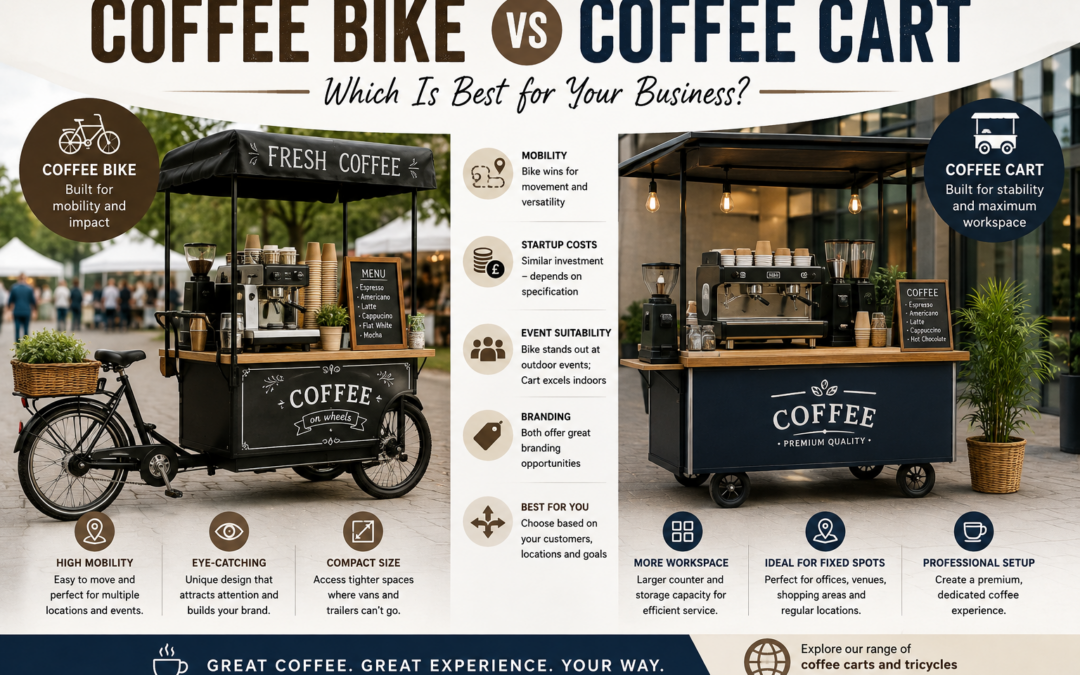
A coffee bike is generally the better choice when mobility and visual impact are priorities, while a coffee cart can provide more working space and flexibility for businesses operating from a relatively fixed location.
Understanding how you intend to trade will help you decide which option offers the best long-term investment.
If you’re currently comparing options, explore Urban Tricycles’ range of coffee carts and tricycles to see the different configurations available.
What Is a Coffee Bike?
A coffee bike is a specially designed tricycle that has been adapted to operate as a mobile coffee station.
Unlike a conventional food van or trailer, a coffee tricycle is compact, distinctive and can be positioned in locations where larger vehicles may be unsuitable.
Depending on its configuration, the bike can incorporate the equipment and storage required for serving coffee and other drinks.
One of its biggest advantages is appearance.
A well-designed coffee bike naturally attracts attention and can become an important part of the branding of a mobile coffee business.
Its unusual format can make it particularly effective at events, exhibitions and busy public spaces where businesses need to stand out.
What Is a Coffee Cart?
A coffee cart provides a dedicated serving station without necessarily incorporating the cycling element of a tricycle.
Carts can be particularly useful for businesses that expect to operate primarily from one location during the trading day.
For example, a coffee cart could be positioned within an office, exhibition, shopping centre, event venue or hospitality environment.
Depending on its design, a cart may provide a larger counter and more room for equipment, ingredients and storage.
For businesses that do not require regular movement between locations during trading, this additional workspace can be a significant advantage.
You can compare different coffee carts and mobile coffee tricycles before deciding which layout best matches your intended business model.
Coffee Bike vs Coffee Cart: What’s the Main Difference?
The biggest difference is mobility.
A coffee bike is specifically designed around a tricycle platform, giving it a distinctive mobile format.
A coffee cart is generally more focused on providing a compact workstation that can be positioned at a chosen trading location.
Neither is automatically better.
The right choice depends on where you intend to trade, how frequently you need to move your setup and how much equipment and storage space your business requires.
For a highly mobile brand attending different events and locations, a coffee bike can be particularly attractive.
For a business operating from a regular pitch or inside a venue, a coffee cart may be the more practical option.
What Are the Advantages of a Coffee Bike?
Mobility
Mobility is one of the most obvious advantages.
Coffee bikes are considerably more compact than vans and trailers, allowing businesses to operate in spaces where larger mobile catering vehicles may be impractical.
This can potentially open up opportunities at events, pedestrian areas, corporate sites and other locations.
Strong Visual Appeal
Coffee bikes are difficult to ignore.
The combination of the tricycle, serving area, equipment and branding creates a distinctive appearance that can help attract customers.
For businesses attending busy events, this visual impact can be particularly valuable.
Branding Opportunities
The body and panels of the bike provide space for branding.
Logos, colours and graphics can transform the tricycle into a highly visible representation of the business.
A branded coffee bike can therefore act as both a sales platform and a marketing tool.
Smaller Footprint
Space is often limited at events and venues.
A compact coffee bike can provide a useful solution when organisers cannot accommodate a full-sized catering vehicle.
What Are the Advantages of a Coffee Cart?
More Focus on Workspace
Coffee carts can be designed around the practical requirements of serving customers.
Depending on the model, this may provide generous counter space and storage for cups, ingredients and other essentials.
Ideal for Fixed Locations
If you intend to trade from the same location for several hours or throughout the working day, the cycling functionality of a tricycle may not be necessary.
A cart can provide a dedicated station that is positioned and prepared for service.
Suitable for Indoor Environments
Coffee carts can work particularly well inside venues such as offices, exhibition centres, hotels and shopping environments.
Their compact footprint can allow businesses to create a coffee service without requiring a conventional café installation.
Professional Presentation
A well-designed cart can create a polished, professional serving area that complements the surrounding venue.
This can be especially valuable for corporate hospitality and premium events.
How Much Does It Cost to Start a Coffee Bike Business?
Startup costs depend heavily on the equipment and specification you choose.
The coffee bike or cart itself is only one part of the overall investment.
You may also need to budget for:
- Coffee machine
- Grinder
- Water system
- Power equipment
- Refrigeration
- Cups and packaging
- Initial coffee and ingredient stock
- Card payment equipment
- Branding and signage
- Insurance
- Licences and registrations
- Transport
- Marketing
Rather than choosing the cheapest platform available, it is worth thinking about the complete setup required to operate efficiently.
Investing in a configuration that matches your intended trading environment can help avoid expensive changes later.
Urban Tricycles’ selection of coffee carts and tricycles provides a useful starting point when planning the physical side of your mobile coffee business.
Which Is Better for Events?
Both can work extremely well at events.
A coffee bike can have an advantage where visual appeal is particularly important.
At festivals, exhibitions, markets and outdoor events, an attractive branded tricycle can help draw attention from people walking past.
Coffee carts can be particularly effective at corporate events, conferences, exhibitions and indoor venues where the business will operate from a designated position.
Consider the types of events you intend to target.
If you expect to attend a mixture of indoor and outdoor events, flexibility should be one of your main priorities when selecting your setup.
Which Is Better for Corporate Coffee?
Coffee carts and bikes can both provide businesses with alternatives to installing a permanent café.
A coffee cart can be positioned in a reception area, office or communal workspace to provide a professional coffee service.
A coffee bike can create a more unusual experience.
This could make it particularly suitable for employee events, promotional campaigns, product launches and corporate hospitality where the presentation of the coffee service is part of the experience.
Which Offers Better Branding Opportunities?
Both provide excellent opportunities for custom branding.
A coffee bike can be particularly eye-catching because the entire structure forms part of the visual identity.
The unusual format also makes branded coffee bikes potentially useful for experiential marketing.
Companies do not necessarily have to operate a dedicated coffee business to use one.
A brand could use a coffee tricycle as part of a promotional event, exhibition or campaign, serving drinks while creating a memorable branded experience.
Coffee carts can also be customised to create a strong branded serving area, particularly in corporate and retail environments.
What About Storage?
Storage is an important practical consideration that can easily be overlooked.
Think about everything required during a typical trading session:
- Coffee beans
- Milk and alternatives
- Cups
- Lids
- Syrups
- Cleaning supplies
- Napkins
- Sugar
- Waste
- Water
- Spare stock
You need enough room to operate efficiently without constantly retrieving supplies from another location.
A larger cart may offer advantages where storage and workspace are priorities.
However, the precise capacity will depend on the individual design and specification, so compare models rather than assuming every cart or tricycle provides the same amount of space.
Think About Power and Water
Serving professional-quality coffee requires more than simply installing an espresso machine.
You need to consider electricity, fresh water and wastewater.
The requirements will depend on your coffee equipment and where you plan to trade.
Some venues may provide convenient access to power, while outdoor events may require a more independent setup.
These practical considerations should be addressed before choosing your cart or bike.
Knowing the equipment you want to operate will help you determine the space, power and water capacity your mobile coffee station requires.
How Important Is Mobility?
Ask yourself what “mobile” actually means for your business.
Do you want to travel between several locations during the same day?
Will the unit remain in one location while you trade and only move between events?
Will it need to operate indoors?
How will you transport it to locations further away?
A coffee bike’s mobility can be a significant advantage, but only if it matches the way you intend to operate.
If your unit will spend most of its time in one fixed location, workspace and serving capacity may be more important considerations.
Coffee Bike or Coffee Cart for a New Business?
For a new independent coffee business, the decision should start with your target customer.
If your plan involves markets, outdoor locations, festivals and events, a coffee tricycle could provide the mobility and distinctive appearance needed to build awareness.
If you already have access to a regular location such as an office building, retail environment or event venue, a coffee cart could provide a practical alternative.
Your budget will also influence the decision, but avoid making price the only consideration.
The most important question is whether the unit will allow you to serve customers efficiently in the locations where you expect to make money.
Which Option Is Right for Your Business?
Choose a coffee bike if mobility, compact dimensions and strong visual impact are central to your business.
It can be particularly effective for:
- Markets
- Festivals
- Outdoor events
- Brand activations
- Weddings
- Promotional events
- Mobile coffee businesses
A coffee cart may be more suitable if workspace and operating from a defined location are your priorities.
It can work particularly well for:
- Offices
- Conferences
- Exhibition venues
- Shopping environments
- Corporate hospitality
- Indoor events
- Regular trading pitches
There will naturally be overlap between the two.
The best option is therefore the one that fits your specific operating model rather than simply the one that looks most impressive.
Build a Mobile Coffee Business That Stands Out
Coffee bikes and coffee carts both provide exciting alternatives to the traditional café model.
They can reduce the need for permanent premises while giving entrepreneurs greater flexibility over where and how they trade.
A coffee bike offers exceptional visual appeal and mobility, while a coffee cart can provide a practical, professional workstation for fixed and semi-permanent locations.
Before making your decision, consider your target customers, locations, available space, equipment, storage requirements and budget.
Planning these elements first makes it much easier to choose a platform that can support the business as it grows.
Explore Urban Tricycles’ range of coffee carts and tricycles to compare the available options and find the right starting point for your mobile coffee business.
