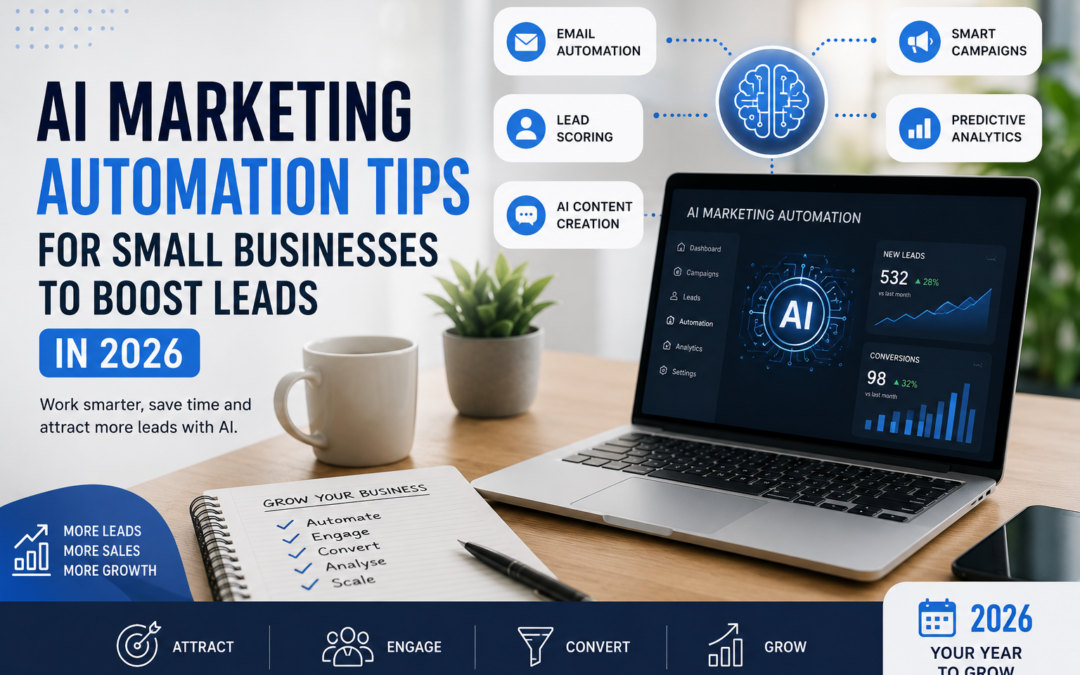
by admin | Aug 10, 2026 | AI MARKETING, MARKETING AUTOMATION
Digital marketing changes quickly, but the fundamentals remain the same: understand your audience, create useful content, make it easy for people to take action, and measure what is working. The challenge for many businesses is not knowing which trends deserve attention and which tactics are just noise. A practical marketing plan should help you reach the right people, earn trust, and turn interest into measurable business results.
Build Your Strategy Around Customer Intent
Before choosing channels or campaign formats, start with customer intent. People interact with your brand at different stages: some are discovering a problem, some are comparing solutions, and others are ready to buy or contact you. Your content and campaigns should match these stages rather than treating every visitor the same.
For example, a person searching for “how to improve email open rates” is likely looking for education, while someone searching for “email marketing agency for ecommerce” may be closer to making a decision. Both searches are valuable, but they need different types of content, calls to action, and follow-up.
Map Content to the Buyer Journey
Create a simple content map with three stages: awareness, consideration, and decision. For awareness, publish educational blog posts, guides, short videos, and social content that answer common questions. For consideration, offer comparisons, checklists, case studies, and product or service explainers. For decision, make sure you have clear landing pages, testimonials, FAQs, and contact options.
This approach helps you avoid creating random content and instead build a system that supports people from first visit to conversion.
Refresh Your Website for Better Conversions
Your website is still the center of your digital marketing activity. Social media posts, ads, email campaigns, and search traffic often lead back to your site. If visitors arrive and cannot quickly understand what you offer or what to do next, your campaigns will struggle.
Start by reviewing your most important pages: homepage, service pages, product pages, pricing or inquiry pages, and key blog posts. Each page should have a clear purpose. Remove unnecessary distractions, improve readability, and make calls to action easy to find.
Improve Page Clarity
Every key page should answer these questions quickly:
What do you offer? Who is it for? Why should someone choose you? What should the visitor do next?
If the answers are buried in long blocks of text or vague messaging, revise the page. Use short paragraphs, descriptive headings, bullet points where helpful, and direct calls to action such as “Book a consultation,” “Request a quote,” “Download the guide,” or “Shop the collection.”
Check the Mobile Experience
Many users will first discover your business on a mobile device. Make sure forms are easy to complete, buttons are large enough to tap, menus are simple, and pages load smoothly. A mobile-friendly site is not just about design; it directly affects whether users stay, read, and convert.
Create Content That Answers Real Questions
Content marketing works best when it is useful, specific, and connected to customer needs. Instead of publishing generic updates, focus on questions your audience is already asking. These questions can come from sales calls, customer support messages, search suggestions, community discussions, and social media comments.
A strong content plan should include both timely and evergreen topics. Timely content allows you to respond to industry changes, seasonal demand, or current conversations. Evergreen content continues to provide value over time because it answers ongoing questions.
Use Practical Formats
Helpful content does not need to be complicated. Some of the most effective formats include how-to guides, comparison articles, checklists, buyer guides, troubleshooting posts, FAQs, and step-by-step tutorials. These formats work because they help users solve a problem or make a decision.
When writing content, avoid focusing only on your company. Instead, explain the issue, provide useful guidance, and naturally show how your product or service fits into the solution when relevant.
Strengthen Your Search Visibility
Search remains an important way for people to find businesses, products, and answers. Good search visibility starts with helpful content, but technical and on-page improvements also matter.
Review your website for basic search optimization. Each important page should have a unique title tag, a clear meta description, descriptive headings, internal links, and content that matches the searcher’s intent. Avoid stuffing keywords into pages. Instead, use natural language and cover the topic thoroughly.
Update Older Content
Refreshing existing content is often more efficient than only creating new posts. Review older blog articles and landing pages to make sure the information is current, examples are still relevant, and links still work. Add missing details, improve formatting, and connect the page to newer related content.
Content updates also give you an opportunity to improve calls to action. If a blog post receives traffic but does not encourage visitors to take another step, add a relevant next action such as reading a related guide, joining an email list, or contacting your team.
Use Email to Build Long-Term Relationships
Email marketing remains valuable because it gives you a direct way to communicate with people who have chosen to hear from you. Unlike social platforms where visibility can change, your email list is an owned audience that you can nurture over time.
To make email more effective, segment your list based on interests, behavior, or customer stage. New subscribers may need educational content, while past customers may respond better to product updates, loyalty messages, or helpful usage tips.
Send Emails With a Clear Purpose
Each email should have one main goal. That goal might be to drive traffic to a new article, encourage event registration, promote a product, request feedback, or educate subscribers about a service. Keep the message focused and make the call to action obvious.
Consistency is more important than volume. Choose a schedule you can maintain and focus on delivering value in every message.
Make Social Media More Strategic
Social media can support awareness, trust, customer engagement, and website traffic, but it works best with a clear plan. Posting simply to stay active often leads to weak results. Instead, define the role each platform plays in your marketing strategy.
For example, one platform may be best for community building, another for short educational content, and another for visual storytelling. Choose platforms based on where your audience spends time and how they prefer to engage.
Balance Content Types
A strong social content mix usually includes educational posts, brand stories, customer-focused content, product or service highlights, behind-the-scenes updates, and direct calls to action. If every post is promotional, audiences may tune out. If no posts invite action, social engagement may not support business goals.
Track which formats lead to saves, shares, comments, clicks, and inquiries. Use those insights to improve future posts rather than relying on assumptions.
Measure What Matters
Digital marketing becomes more effective when you measure the right things. Vanity metrics can be useful for spotting interest, but they do not tell the full story. Focus on metrics connected to your goals, such as qualified leads, sales inquiries, conversion rates, email signups, repeat visits, and revenue-related actions.
Set up tracking for important website actions, including form submissions, phone clicks, downloads, bookings, and purchases where applicable. Review performance regularly so you can identify what is improving and what needs adjustment.
Turn Reports Into Decisions
A report is only useful if it leads to action. If a landing page gets traffic but few conversions, test the headline, offer, form length, or call to action. If an email has strong clicks, consider creating more content around that topic. If a campaign brings traffic that does not engage, revisit your audience targeting or message.
Small, consistent improvements often create better results than occasional major changes.
Create a Simple Monthly Marketing Checklist
To keep your strategy organized, use a monthly checklist. Review website performance, update one or two key pages, publish new content, refresh older content, send email campaigns, evaluate social media results, and check lead quality. This routine keeps your marketing active without becoming overwhelming.
Also schedule time to review customer feedback. The language customers use can improve your ad copy, website messaging, blog topics, and email subject lines. Your audience often tells you exactly what they care about; your job is to listen and respond with useful marketing.
Final Thoughts
A successful digital marketing strategy does not need to chase every new tactic. It needs clear goals, useful content, strong website experiences, consistent communication, and regular measurement. By focusing on customer intent and improving each part of your marketing system, you can build campaigns that attract the right audience and support meaningful business growth.

by admin | Jul 16, 2025 | AI MARKETING
The world of search is evolving faster than ever, and businesses determined to stay visible on Google can’t rely on old-school SEO tactics alone. Today, winning the Search Engine Results Page (SERP) game demands a blend of creative strategy and cutting-edge technology. At SEO Dogs, we’re seeing one powerful force shape the future of SEO: Artificial Intelligence (AI).
From earning eye-catching rich results to optimising for Answer Engine Optimisation (AEO) and improving how we track performance, AI is transforming how businesses get found online. Here’s how you can harness it to boost your website’s rankings and traffic.
Earning Rich Results with AI
Rich results — those expanded SERP listings featuring images, ratings, FAQs, and more — can dramatically increase your organic click-through rates. But securing them requires more than simply plugging keywords into your content.
AI tools can help identify the specific types of rich results relevant to your industry, analysing which SERP features appear most frequently for your target queries. For example, AI-driven content analysis platforms can scan top-ranking pages to see whether Google is favouring video carousels, FAQs, or featured snippets for a given search term.
Armed with this insight, you can tailor your content and structured data accordingly. Whether it’s creating concise, snippet-friendly paragraphs or adding schema markup to highlight reviews, AI helps ensure your pages are primed to win those premium spots in the SERPs.
AEO: Optimising for the Era of Answers
Search behaviour is shifting from simple keyword searches to conversational queries and voice searches, fuelling the rise of Answer Engine Optimisation (AEO). Instead of just ranking for keywords, businesses now need to ensure their content directly answers specific questions.
AI excels at parsing user intent and identifying question-based opportunities. Tools powered by natural language processing can surface the exact questions users are asking, from “how to choose the best SEO agency” to “what is schema markup?”, enabling you to craft precise, authoritative content.
Beyond identifying questions, AI helps you structure content for better chances of appearing as a featured snippet or voice answer. For instance, summarising answers in under 50 words or presenting information in a bullet-point list can increase your odds of being selected as Google’s chosen answer.
Smarter Performance Tracking with AI
Traditional SEO tracking tools are useful but often reactive, telling you where your rankings stand today rather than predicting where they might go tomorrow. This is where AI steps in to deliver smarter performance insights.
AI-powered analytics tools can detect subtle trends and anomalies in your traffic or rankings before they become major issues. For example, they can spot a sudden drop in impressions for a crucial keyword and alert you immediately, allowing for faster intervention.
Moreover, AI can forecast SEO performance based on historical data, competitor movements, and even seasonality. This enables businesses to allocate resources strategically, doubling down on high-opportunity keywords or emerging SERP features.
At SEO Dogs, we integrate AI tools to deliver proactive SEO strategies, helping our clients not just keep up but stay ahead of the competition.
Embrace the Future of SEO
AI isn’t just a buzzword, it’s reshaping every corner of SEO. From earning rich results that boost your visibility, to conquering the answer-driven search landscape, to tracking performance with unprecedented precision, AI is a game-changer.
For businesses serious about dominating the SERPs, now’s the time to embrace AI-driven SEO services. At SEO Dogs, we’re committed to helping you leverage the latest technology to secure lasting, measurable results.
Ready to take your SEO to the next level? Click here, or get in touch with SEO Dogs and let’s win the SERP game together.

by admin | Jul 16, 2025 | AI MARKETING
Search marketing has entered a thrilling new era, driven by rapid advances in artificial intelligence (AI). For businesses seeking to stay ahead in the SEO game, understanding how AI shapes search behaviour and search engine results pages (SERPs) is no longer optional—it’s essential. From featured snippets to the emerging world of Answer Engine Optimisation (AEO), AI-powered search marketing is transforming how brands connect with their audiences online.
The Rise of AI in Search
Search engines like Google have long used AI to improve their algorithms, but recent innovations such as machine learning and natural language processing (NLP) have turbocharged this evolution. Google’s BERT and MUM updates, for example, enable search engines to better understand the context and intent behind a user’s query, not just the keywords.
This shift means traditional keyword-stuffing tactics are firmly obsolete. Instead, search marketers must focus on creating high-quality, authoritative content that genuinely answers users’ questions. AI is driving this change by demanding relevance and context in every piece of online content.
Featured Snippets
One of the most visible outcomes of AI’s influence on search is the growth of featured snippets. These are the concise, information-rich boxes that appear at the top of many Google search results, often labelled as “Position Zero.”
AI helps search engines select the most relevant snippet of content to display, pulling information directly from web pages. This creates both an opportunity and a challenge for SEO professionals. Securing a featured snippet can dramatically increase visibility, credibility and click-through rates. However, if your content doesn’t align with user intent or isn’t structured in a way that search engines can easily extract, you’ll be overtaken by competitors who have optimised for this coveted spot.
To compete for featured snippets, businesses should:
-
Structure content clearly with headings and bullet points
-
Provide concise, direct answers to common questions
-
Use schema markup where relevant
-
Focus on long-tail keywords and natural language queries
Enter Answer Engine Optimisation (AEO)
While featured snippets dominate today’s SERPs, AI is steering search towards an even more conversational and answer-driven future. Enter Answer Engine Optimisation (AEO).
AEO refers to the practice of tailoring content to provide precise, authoritative answers that AI-driven platforms—such as voice assistants (e.g., Siri, Alexa) or AI chatbots—can directly deliver to users. Rather than merely ranking on a list of search results, the goal is for your content to become the definitive answer AI tools cite when responding to queries.
This has significant implications for SEO:
-
Voice Search: Voice searches tend to be longer and phrased as natural questions. AEO focuses on understanding and targeting these conversational queries.
-
Zero-Click Searches: Increasingly, users get their answers directly from search engines or AI assistants without clicking through to a website. Businesses need to ensure their content is structured and authoritative enough to be chosen as the source for these direct answers.
-
Entity-Based SEO: AI uses entities (people, places, concepts) to understand context and relationships between topics. Optimising your content around entities and semantic connections helps you become the trusted source for AI-driven answers.
Preparing Your SEO Strategy for an AI Future
AI-powered search marketing is not just a passing trend; it’s the future of how people discover and interact with online information. Businesses that adapt early will gain a competitive edge.
To future-proof your SEO:
-
Focus on user intent and providing genuinely helpful content
-
Optimise for conversational queries and natural language
-
Structure your content for easy extraction by AI tools
-
Embrace schema markup and structured data
-
Stay informed about emerging AI technologies and updates
At SEO Dogs, we help businesses navigate this changing landscape, blending proven SEO strategies with cutting-edge AI insights. The shift towards AI-driven search is already underway—make sure your business is ready to lead, not follow.
by admin | Apr 22, 2025 | AI MARKETING
In today’s rapidly advancing digital environment, staying informed about key trends is crucial for marketers aiming to remain competitive. As we move further into 2025, three areas stand out for their transformative impact: artificial intelligence in content marketing, changes in email open rates, and notable shifts in paid media strategies. Here, we explore the top insights in each domain and what they mean for digital marketing professionals.
The Rise of AI in Content Marketing
Artificial intelligence is no longer a futuristic concept in content marketing – it’s a practical tool driving real-world results. Marketers are increasingly using AI to generate content, optimise existing assets, and personalise user experiences at scale.
AI-powered writing tools like ChatGPT and Jasper are now being used to draft blog posts, product descriptions and even ad copy. While human oversight remains essential, these tools significantly reduce production time and increase efficiency. However, success with AI still depends on the input and direction provided by skilled marketers – creativity and strategic thinking cannot be automated.
Moreover, AI is proving invaluable for content personalisation. Platforms can now analyse user behaviour and segment audiences more accurately, delivering content tailored to individual preferences. This not only improves engagement but also supports better conversion rates.
For brands, the challenge lies in balancing automation with authenticity. As AI-generated content becomes more prevalent, maintaining a consistent brand voice and ensuring factual accuracy will be critical.
Email Open Rates in a Post-iOS 15 World
Email marketing has long been a cornerstone of digital strategy, but recent privacy changes – particularly Apple’s Mail Privacy Protection (MPP) rolled out with iOS 15 – have significantly impacted how marketers track performance.
Previously, open rates were a key metric. With MPP now hiding user activity, many marketers have reported inflated open rates, making this metric far less reliable. As a result, focus has shifted toward more meaningful indicators like click-through rates, conversion data, and subscriber engagement over time.
In response, brands are also rethinking their segmentation and personalisation strategies. There’s a growing emphasis on zero-party data – information users voluntarily share – to create more relevant and valuable email content. Preference centres, surveys, and interactive content are proving useful in gathering this data.
Additionally, subject lines and send times are being tested more rigorously to account for decreased visibility into recipient behaviour. Deliverability and email design have also taken on greater importance, ensuring content resonates regardless of whether it’s opened or tracked.
Paid Media: Strategic Shifts in 2025
The paid media landscape has undergone significant shifts over the past year. With rising ad costs, increasing privacy regulations, and growing competition for user attention, marketers are being forced to rethink their strategies.
One key trend is the diversification of ad spend. While platforms like Google Ads and Meta remain dominant, more brands are exploring alternative channels such as TikTok, LinkedIn, Reddit, and even programmatic audio and streaming TV. These platforms offer niche targeting opportunities and often come with lower costs per click or impression.
There’s also a noticeable shift towards performance-driven creative. With machine learning handling much of the audience targeting, creative elements now play a bigger role in campaign success. Marketers are focusing on producing more variants of ad creative, testing headlines, visuals, and calls to action more rigorously than ever before.
Another major development is the increased use of first-party data. As cookies phase out, brands are investing in CRM systems, loyalty programmes, and gated content strategies to gather user data directly. This not only improves targeting but also aligns with growing consumer expectations around privacy.
Final Thoughts
Digital marketing is shifting rapidly, and staying ahead requires adaptability, insight, and strategic thinking. AI is transforming content creation, email marketers are redefining success metrics, and paid media strategies are becoming more diversified and data-driven.
By embracing these changes and continuing to learn, marketers can build smarter campaigns that resonate with their audiences – and drive better results across the board.
